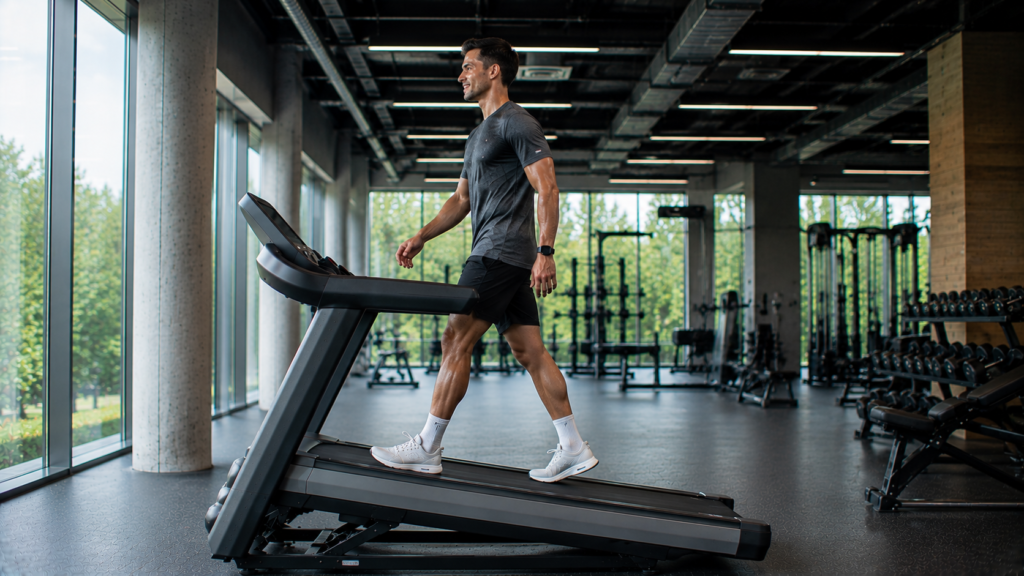
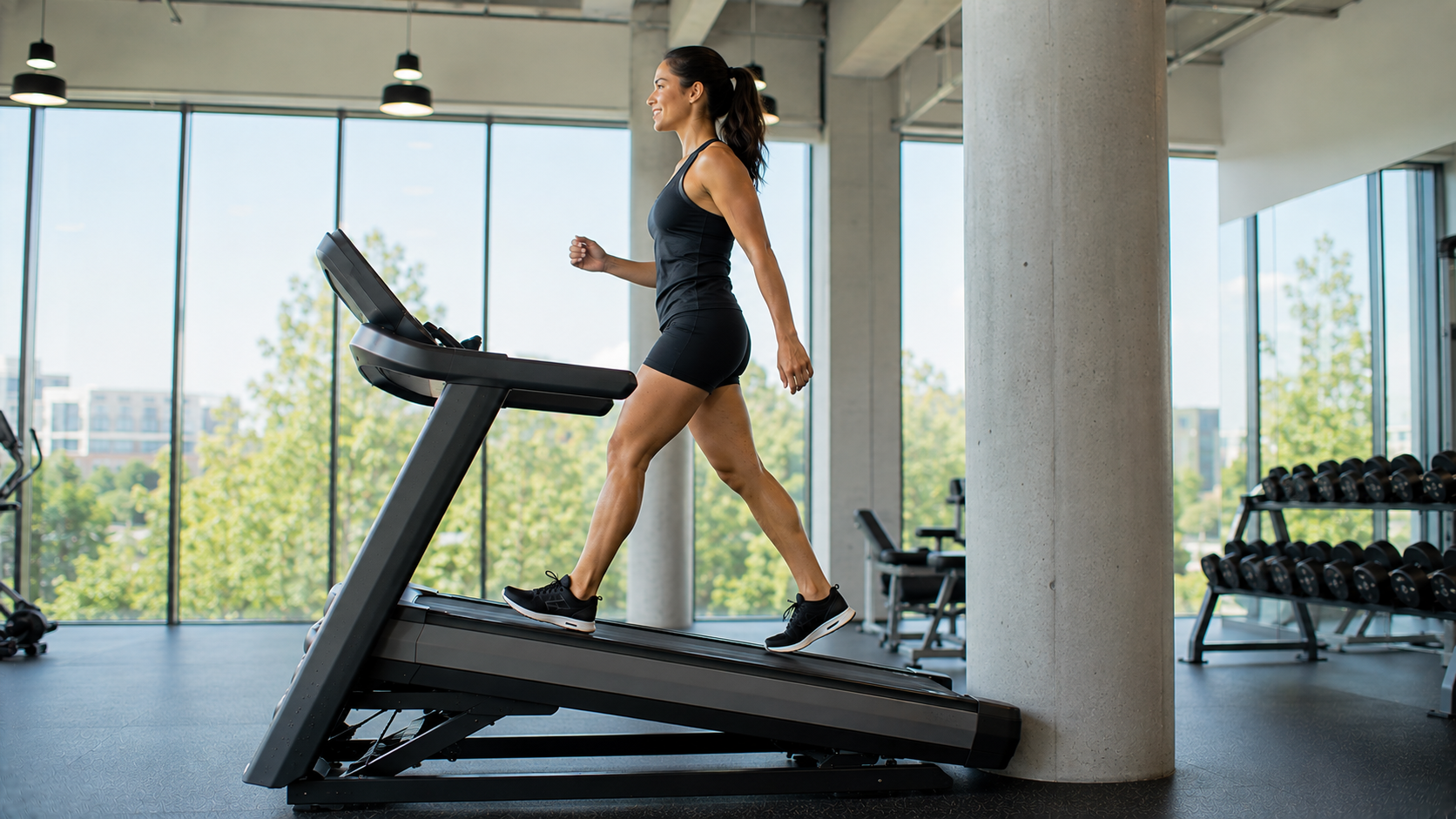
If you’ve ever increased the incline on a treadmill and immediately felt your legs and lungs working harder, you’ve probably wondered: does walking on an incline burn more calories?
The short answer is yes. Walking uphill generally requires more energy than walking at the same speed on a flat surface because your body has to work against gravity. Your heart rate usually increases, your leg muscles work harder and the overall intensity of the exercise rises.
However, exactly how many additional calories you burn depends on several factors. The incline percentage, walking speed, body weight, workout duration and whether you hold onto the treadmill can all influence the result.
This is important because simply increasing the incline as high as possible doesn’t automatically create the best walking workout.
If you’re asking does walking on an incline burn more calories because you’re trying to lose weight, you also need to consider whether you can maintain the workout consistently. A steep incline may increase calorie expenditure, but a moderate incline that allows you to walk comfortably for longer could sometimes produce a greater total calorie burn.
Walking itself can already be an effective form of cardiovascular exercise.
Adding an incline simply gives you another way to increase the challenge without necessarily progressing to running.
In this guide, we’ll answer does walking on an incline burn more calories, compare different treadmill gradients, examine how incline affects your muscles and heart rate, and explain how to use incline walking effectively for weight loss.
You’ll also see estimated calorie comparisons between flat and incline walking, practical treadmill workouts and the most common mistakes that can reduce the effectiveness of your sessions.
By the end, you’ll know exactly why incline matters and how to use it without unnecessarily making every walk exhausting.

Why Does Walking on an Incline Burn More Calories?
To understand does walking on an incline burn more calories, it helps to understand what changes when the ground beneath you begins to rise.
When you walk on flat ground, your muscles primarily move your body forwards.
Once you begin walking uphill, you also have to raise your body against gravity with each step. That increases the amount of work required from your lower-body muscles and generally raises the energy cost of the activity.
Your glutes, calves, quadriceps and hamstrings all contribute to uphill walking, although the exact muscular demands change according to the gradient and your walking technique.
Your cardiovascular system also has to respond to the additional workload. As the exercise becomes more demanding, your heart rate and breathing rate generally increase to help deliver oxygen to your working muscles.
This is why the same walking speed can feel dramatically different at different gradients.
Walking at 3 mph on a completely flat treadmill may feel comfortable.
Keep the speed at 3 mph and gradually increase the treadmill to 5%, 8% or 10%, and the workout can become considerably harder despite your speed remaining unchanged.
Researchers and exercise professionals often describe exercise intensity using metabolic equivalents, commonly called METs. Higher MET values indicate greater energy expenditure relative to rest.
The Compendium assigns different energy costs to walking activities depending on factors including speed and gradient, illustrating why uphill walking generally requires more energy than level walking.
So, does walking on an incline burn more calories? Under comparable conditions, yes. Increasing the gradient generally increases the energy required to complete the activity.
But incline isn’t the only variable that matters.
How Many More Calories Does Incline Walking Burn?
This is where things become more interesting.
There isn’t one percentage by which incline walking always increases calorie expenditure.
If you’re researching does walking on an incline burn more calories, you’ll sometimes encounter claims that incline walking burns a specific percentage more calories than flat walking. Those figures should be treated carefully because the difference depends on the exact workout being compared.
A person walking at:
- 2.5 mph at 3% incline
is performing a very different workout from someone walking at:
- 3.5 mph at 12% incline.
Body weight matters as well. Generally, a heavier person requires more energy to move their body through the same activity than a lighter person.
Workout duration also changes the total.
Walking uphill for ten minutes may have a higher calorie-burning rate than walking flat for ten minutes, but a 60-minute flat walk could still burn more total calories than a very short incline session.
If you’d like a deeper explanation of the variables affecting walking calorie expenditure, we’ve covered them separately.
Estimated Flat vs Incline Walking Calories
The following table provides an illustrative comparison for a person weighing approximately 70 kg (154 lb). Actual calorie expenditure varies between individuals and machines, so these figures should be treated as estimates rather than guarantees.
| Walking Workout | 30-Minute Estimated Calories | Relative Difficulty |
| 3 mph, 0% incline | 110-130 | Easy-moderate |
| 3 mph, 3% incline | 140-165 | Moderate |
| 3 mph, 5% incline | 165-195 | Moderate-challenging |
| 3 mph, 8% incline | 200-235 | Challenging |
| 3 mph, 10% incline | 225-265 | Challenging |
| 3 mph, 12% incline | 250-295 | Hard |
These figures aren’t intended to tell you exactly what your treadmill session will burn. Their purpose is to demonstrate the general relationship: as gradient increases while other variables remain similar, energy expenditure generally rises.
This provides a straightforward answer to does walking on an incline burn more calories than flat walking.
Yes—but you don’t need to immediately jump to a 12% or 15% incline.
A relatively modest gradient can make your usual walking pace more demanding.
Does a Higher Incline Always Burn More Calories?
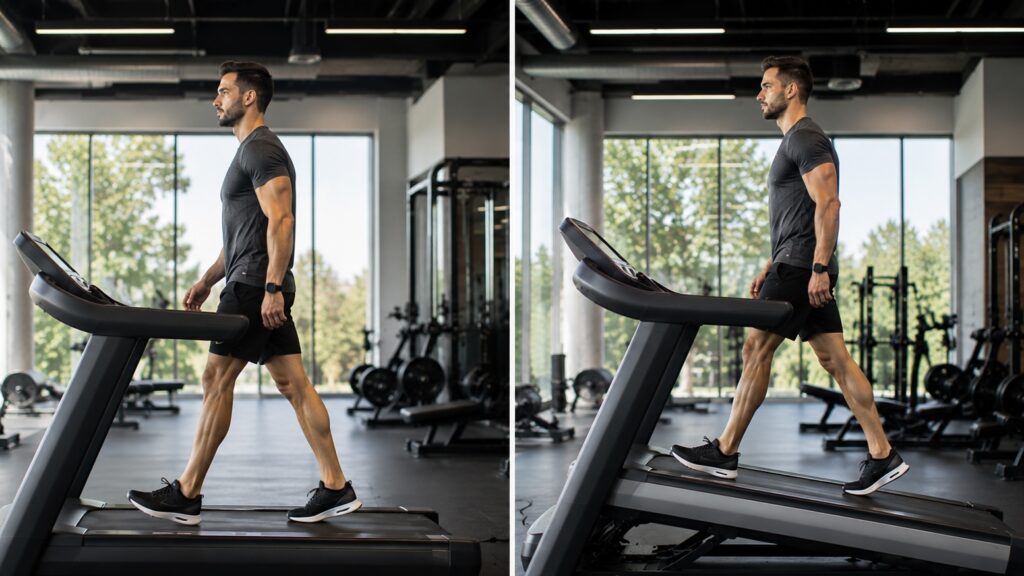
Generally, increasing the gradient increases the energy demand if the other major variables remain comparable.
But there is an important catch.
People often change their behaviour as the incline becomes steeper.
Imagine you’re comfortably walking at 3.5 mph on a 5% gradient. You then increase the treadmill to 15%.
You might:
- Reduce your walking speed significantly.
- Shorten your workout.
- Hold onto the treadmill.
- Lean heavily backwards.
- Take much smaller steps.
- Need frequent breaks.
At that point, comparing the two workouts becomes more complicated.
This is why answering does walking on an incline burn more calories isn’t as simple as saying the highest possible incline is always best.
Your goal should be finding a gradient that increases the challenge while still allowing you to maintain good walking mechanics and complete enough exercise to support your goals.
For a beginner, that might be only 2–4%.
Someone with more walking experience may comfortably use 5–8% for sustained periods.
Higher gradients can then be introduced for shorter intervals if appropriate.
There is no requirement to walk at 12% or 15% simply because your treadmill can reach those numbers.
If your technique deteriorates significantly, reducing the incline is usually more sensible than fighting to maintain an arbitrary setting.
Does Walking on an Incline Burn More Calories Than Walking Faster?
Both strategies can increase exercise intensity.
You can make a walking workout harder by increasing:
Speed, incline, or a combination of both.
This creates several ways to progress your workouts without immediately switching to running.
For example:
| Workout | Speed | Incline | Primary Progression |
| A | 3.0 mph | 0% | Baseline |
| B | 3.5 mph | 0% | Increased speed |
| C | 3.0 mph | 5% | Increased incline |
| D | 3.3 mph | 5% | Speed + incline |
Which one burns the most calories depends on the exact intensity, your body size and how long you maintain the session.
That’s why does walking on an incline burn more calories than simply walking faster doesn’t have one universal answer.
Both can increase energy expenditure.
Incline walking is particularly useful for people who want to make walking harder without dramatically increasing their speed.
Someone who doesn’t enjoy running, for example, can use gradients to create a challenging cardiovascular workout while remaining at a walking pace.
The best option is usually the one that allows you to reach an appropriate intensity while maintaining good technique and completing your intended workout.
What Incline Is Best for Burning Calories?
There isn’t one perfect treadmill incline for everyone.
If you’re asking does walking on an incline burn more calories, it can be tempting to assume that setting the treadmill to the highest gradient available will produce the best results.
It isn’t necessary.
For many people, a moderate incline around 3–8% provides a useful balance between increasing exercise intensity and maintaining a sustainable walking pace.
Beginners should generally start towards the lower end and gradually progress as their fitness improves.
Here’s a simple way to think about it:
| Incline | How It May Feel | Potential Use |
| 0-2% | Easy-moderate | Warm-ups, beginners, recovery |
| 3-5% | Moderate | Sustained brisk walking |
| 6-8% | Moderate-hard | More challenging steady walking |
| 9-12% | Hard | Shorter challenging periods |
| 12%+ | Very hard for many | Intervals / experienced walkers |
These aren’t strict rules. Treadmills vary, and your speed dramatically affects how difficult each gradient feels.
Instead of choosing an incline solely from a chart, monitor your effort.
The CDC describes moderate-intensity physical activity as activity where you can generally talk but not sing during the exercise.
If your goal is a sustained moderate-intensity walk, this talk test can be more useful than obsessing over whether the treadmill displays 5%, 6% or 7%.
The best calorie-burning incline is ultimately one that challenges you enough to increase your energy expenditure while remaining sustainable for the intended workout duration.

Does Incline Walking Help With Weight Loss?
Yes, incline walking can support weight loss.
However, this requires an important distinction.
Incline walking doesn’t cause weight loss simply because the treadmill is elevated.
Weight loss occurs when your overall energy balance creates a calorie deficit over time. Incline walking can contribute by increasing the amount of energy you expend during exercise.
So when someone asks does walking on an incline burn more calories specifically because they want to lose weight, the answer is useful—but calorie burn is only part of the overall process.
Regular walking, nutrition, total daily activity and consistency all matter.
For example, someone completing three challenging incline walks each week but remaining almost completely inactive during the rest of their time may have a different total energy expenditure from someone who performs moderate walks while remaining active throughout every day.
Daily steps can therefore complement dedicated incline sessions.
Incline walking has another potential advantage: it allows you to increase workout intensity without necessarily running.
That can be useful for people who prefer walking or simply enjoy treadmill workouts.
But don’t make the mistake of believing the hardest possible session will automatically produce the fastest weight loss.
A routine you can complete three or four times every week for several months is generally more useful than an extreme workout you abandon after two weeks.
If does walking on an incline burn more calories is the question that brought you here, remember the bigger picture: yes, it does under comparable conditions, but sustainable weight loss still depends on your overall habits.

Does Incline Walking Work More Muscles?
Incline walking changes the mechanical demands of walking.
As the gradient rises, your lower body has to contribute more to moving you forwards and upwards.
Your:
- Glutes
- Calves
- Quadriceps
- Hamstrings
all contribute to walking uphill.
You may particularly notice your calves and glutes working harder compared with comfortable level walking.
However, don’t confuse increased muscular demand with traditional strength training.
Incline walking can challenge your lower-body muscles, but it isn’t a complete replacement for progressive resistance training if your goal is to build significant strength or muscle.
For general fitness, though, the increased muscular involvement is another reason incline walking can feel substantially harder than flat walking.
It also helps explain does walking on an incline burn more calories: you’re asking your body to perform more demanding work with each step.
Does Holding the Treadmill Reduce Calorie Burn?
This is one of the most important incline-walking mistakes.
If you increase the treadmill to a steep gradient but then support a large amount of your body weight by gripping or leaning heavily onto the handrails, you’re changing the exercise.
Holding the rails briefly for balance or when adjusting the treadmill is different from continuously hanging backwards from them throughout your workout.
If you can’t comfortably maintain your walking posture without heavily relying on the rails, the incline or speed may simply be too high.
Reducing the gradient and walking naturally can give you a more representative uphill-walking workout.
Keep your torso relatively upright, look forwards and allow your arms to move naturally.
This also makes it easier to compare your progress from one session to another.
If last month you could comfortably walk at 3 mph and 4% incline without holding on, and you can now perform the same duration at 6%, that’s meaningful progression.
Don’t chase a higher treadmill number at the expense of the actual exercise.
Does Incline Walking Burn More Calories Than Running?
Running generally burns more calories per minute than walking because it requires greater energy expenditure and usually produces a higher exercise intensity.
However, incline walking can significantly narrow the gap.
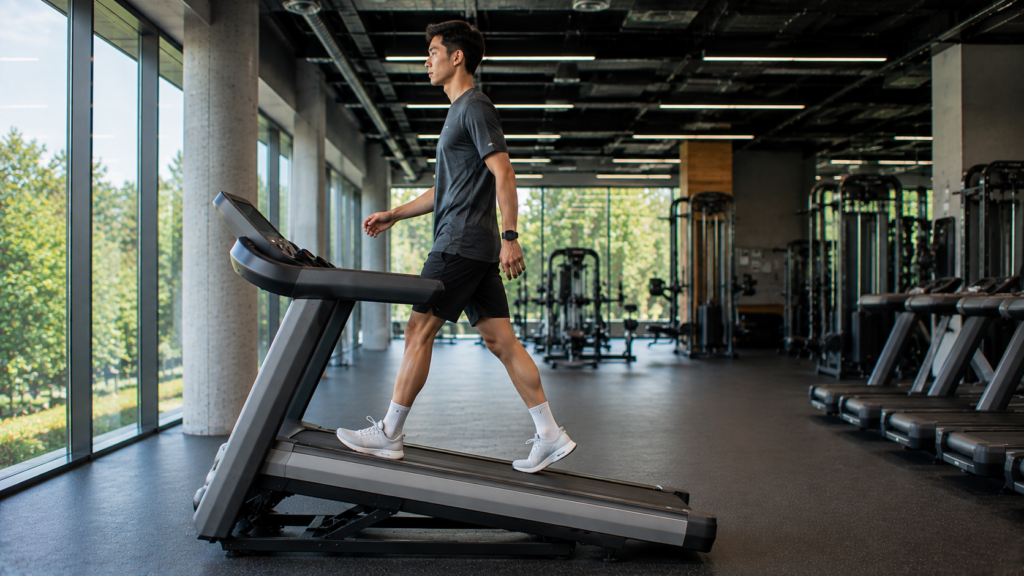
A fast walk at a challenging gradient may require considerably more effort than a slow walk on flat ground. This makes incline walking useful for people who want a demanding cardiovascular workout without necessarily progressing to running.
So, does walking on an incline burn more calories than running?
Not necessarily.
If workout duration and body weight are similar, running will often produce greater calorie expenditure than moderate incline walking. But the comparison changes depending on speed, gradient and how long each activity is performed.
For example, someone may comfortably complete a 45-minute incline walk but only manage 20 minutes of continuous running. Even if running burns more calories per minute, the longer walking session could narrow the difference in total calories burned.
This is why comparing exercises exclusively by calories burned per minute can be misleading.
Running also creates greater impact forces than walking, while walking keeps at least one foot in contact with the ground throughout the gait cycle. Some people therefore find walking easier to perform frequently.
If you’re deciding between the two specifically for weight loss, we’ve compared them in greater detail separately.
Ultimately, the best exercise depends on your goals, fitness level, preferences and ability to recover.
If you enjoy running and tolerate it well, there’s no reason to replace it completely with incline walking.
Equally, if you prefer walking, increasing the gradient provides a simple way to make your sessions more challenging.
When considering does walking on an incline burn more calories, think of incline as an intensity tool rather than a replacement for every other form of cardio.
How Long Should You Walk on an Incline to Burn Calories?
There isn’t one perfect duration.
A useful incline walking workout could last anywhere from around 20 to 60 minutes, depending on your fitness, gradient, speed and training goals.
Beginners may benefit from starting with shorter periods at relatively gentle gradients.
For example, you might begin with 20–30 minutes and gradually increase either the duration or incline as your fitness improves.
Someone more experienced might comfortably complete 45–60 minutes at a moderate gradient.
The important thing is not to increase everything simultaneously.
If you increase your:
- Speed
- Incline
- Duration
all at once, your workout can become dramatically harder.
Instead, progress one variable gradually.
For example, if you currently walk for 30 minutes at 3 mph and 3% incline, you could first progress to 35 minutes while keeping the speed and gradient unchanged.
Alternatively, keep the session at 30 minutes and gradually increase the incline.
This makes progression easier to monitor and gives your body time to adapt.
When asking does walking on an incline burn more calories, duration is particularly important because total calorie expenditure accumulates throughout the workout.
A steep incline may burn calories at a higher rate, but that advantage becomes less useful if you can only sustain it for a few minutes.
A moderate incline that allows you to complete a longer session may therefore be the better option for some people.
Adults should aim to accumulate at least 150 minutes of moderate-intensity physical activity each week, according to current NHS guidance.
That doesn’t mean all 150 minutes need to come from incline treadmill walking. Your weekly activity can include walking, cycling, swimming and other appropriate forms of exercise.
The bigger goal is building an active lifestyle rather than relying on one individual workout.
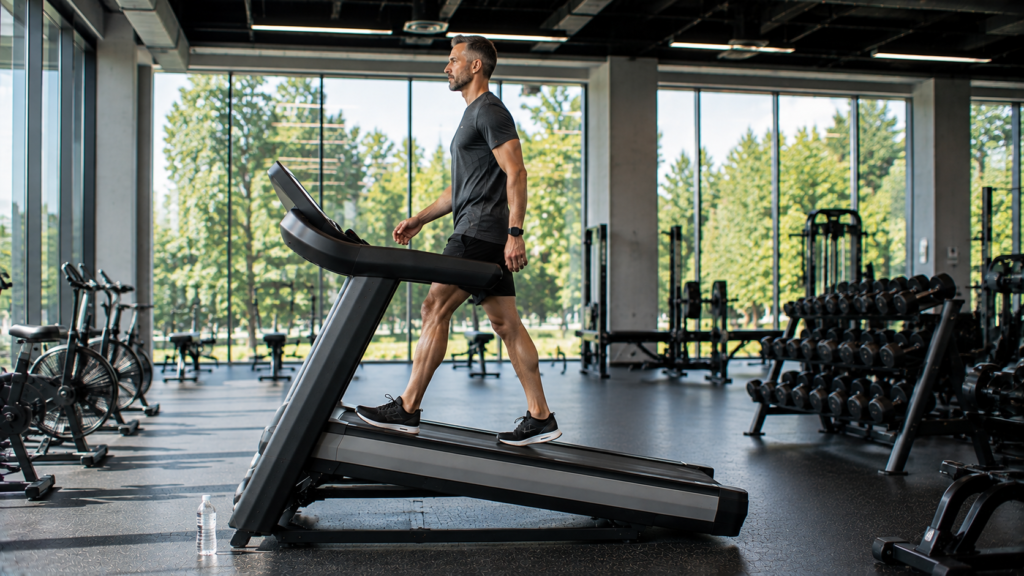
Is Incline Walking Better for Far Loss?
Incline walking can be an effective part of a fat-loss programme, but it doesn’t specifically force your body to lose fat from particular areas.
You can’t choose where your body removes fat simply by selecting a particular exercise.
Instead, reducing body fat generally requires maintaining an overall calorie deficit over time.
Incline walking can help because it increases energy expenditure.
This brings us back to the central question: does walking on an incline burn more calories?
Compared with walking at the same speed on level ground, generally yes.
That additional energy expenditure can contribute towards the calorie deficit required for weight loss.
However, the difference between flat and incline walking shouldn’t distract you from the fundamentals.
Your overall results still depend on factors such as:
- Total physical activity.
- Food intake.
- Workout consistency.
- Exercise duration.
- Sleep and recovery.
- Your starting body weight.
- How long you maintain your routine.
For example, someone might complete an excellent incline walking session and burn a meaningful number of calories, but then consume significantly more food because they believe the workout has “earned” it.
This can reduce or eliminate the calorie deficit they were trying to create.
Fitness trackers can be useful for monitoring exercise, but their calorie estimates shouldn’t be treated as perfectly accurate measurements.
The most effective approach is usually combining regular activity with a sustainable eating pattern rather than trying to compensate for food through increasingly difficult workouts.
If weight loss is your main goal, incline walking should therefore be viewed as one tool within a larger strategy.
And because walking is relatively accessible, many people find it easier to perform consistently than more demanding forms of exercise.
Is Incline Walking Better Than Flat Walking for Weight Loss?
If every other variable were identical, incline walking would generally have the advantage for calorie expenditure.
Imagine walking:
30 minutes at 3 mph and 0% incline
versus:
30 minutes at 3 mph and 6% incline.
The second workout requires your body to work harder against gravity, so energy expenditure would generally be higher.
That makes the answer to does walking on an incline burn more calories straightforward when the comparison is controlled.
But real workouts aren’t always controlled.
You may enjoy walking outdoors on flat ground enough to complete an hour, whereas you might become bored or fatigued after 25 minutes on an inclined treadmill.
In that situation, flat walking could still contribute significantly to your weekly calorie expenditure simply because you perform more of it.
This is why you shouldn’t stop doing ordinary walking once you discover incline walking.
Both can serve different purposes.
Flat walking is excellent for:
- Increasing your daily step count.
- Longer comfortable walks.
- Recovery days.
- Beginners.
- Everyday movement.
Incline walking is useful for:
- Increasing exercise intensity.
- Making treadmill sessions more challenging.
- Increasing energy expenditure at a given speed.
- Adding variety to walking workouts.
- Challenging the lower body differently.
The two can easily coexist.
You might complete one or two dedicated incline sessions each week while continuing to accumulate ordinary walking throughout your day.
This can be particularly effective if you’re using walking to support weight management because it allows you to increase both structured exercise and general daily movement.
Can Beginners Do Incline Walking
Absolutely.
Beginners don’t need to avoid incline walking—they simply need to start appropriately.
One of the biggest mistakes is copying an advanced treadmill workout from social media and immediately attempting steep gradients for long periods.
If you’re new to regular exercise, start with comfortable flat walking first.
Once you can maintain a purposeful walking pace comfortably, introduce a small incline.
For example:
Beginner Incline Walking Progression
| Stage | Duration | Speed | Incline |
| 1 | 20-25 min | Comfortable | 0-2% |
| 2 | 25-30 min | Comfortable-brisk | 2-3% |
| 3 | 30 min | Brisk | 3-4% |
| 4 | 30-35 min | Brisk | 4-5% |
| 5 | 35-40 min | Brisk | 5-6% |
These aren’t mandatory settings.
Your treadmill, walking ability and fitness level may make a particular combination considerably easier or harder than it appears on paper.
Use the table as an example of gradual progression, not a test you have to pass.
If you’re completely new to exercise, walking itself is already a perfectly reasonable starting point.
Once your body becomes accustomed to regular walking, increasing the gradient can provide a simple progression.
This is another reason the answer to does walking on an incline burn more calories is useful for beginners: you don’t necessarily need to start running to make your cardio progressively harder.
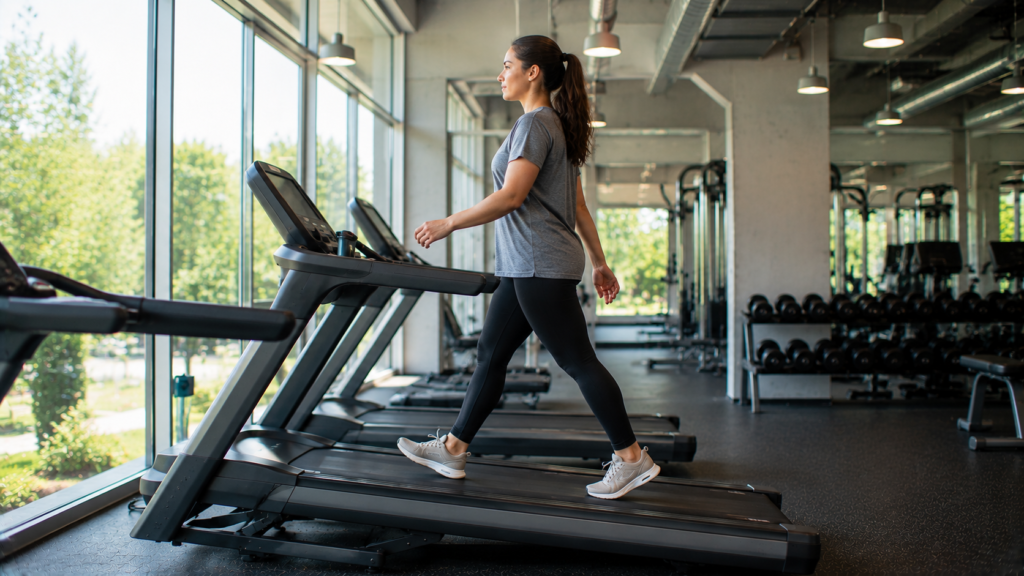
A Simple 30-Minute Incline Walking Workout
If you want to put everything into practice, you don’t need a complicated treadmill programme.
Here’s an example of a progressive 30-minute incline walking workout.
30-Minute Incline Walking Workout
| Time | Incline | Effort |
| 0-5 min | 0-2% | Easy warm-up |
| 5-10 min | 3% | Moderate |
| 10-15 min | 5% | Moderate-challenging |
| 15-20 min | 6% | Challenging |
| 20-25 min | 4% | Moderate |
| 25-30 min | 0-2% | Easy cool-down |
Choose a walking speed that allows you to maintain good posture throughout the session.
The exact speed will vary considerably between individuals, which is why prescribing one universal treadmill speed isn’t necessary.
You should be able to walk naturally without hanging onto the treadmill.
If the 6% section feels too difficult, reduce it.
If the entire workout eventually becomes easy, you can gradually increase either your speed, incline or duration.
Don’t increase all three simultaneously.
The purpose of the workout is to create a sustainable challenge, not to make yourself as exhausted as possible.
If you’re wondering does walking on an incline burn more calories during this type of session compared with the same workout performed completely flat, the increased gradient generally raises the energy requirement.
But the best progression is still the one you can perform consistently.
A More Challenging Incline Interval Workout
Once you’ve developed a good walking base, incline intervals can add variety.
Instead of maintaining one gradient throughout the session, you alternate between easier and harder inclines.
For example:
| Time | Incline | Intensity |
| 0-5 min | 1% | Warm-up |
| 5-8 min | 5% | Moderate |
| 8-10 min | 2% | Easier |
| 10-13 min | 7% | Hard |
| 13-15 min | 2% | Easier |
| 15-18 min | 8% | Hard |
| 18-20 min | 2% | Easier |
| 20-23 min | 7% | Hard |
| 23-25 min | 2% | Easier |
| 25-30 min | 0-1% | Cool-down |
Again, adjust the gradients according to your ability.
During the harder intervals, your breathing should increase and your legs should feel like they’re working, but you should still maintain controlled walking mechanics.
The easier sections allow you to recover without completely stopping.
This creates a useful treadmill session for someone who finds continuous incline walking monotonous.
It also demonstrates another way to use the answer to does walking on an incline burn more calories practically: rather than simply setting the treadmill as steep as possible, you can manipulate the gradient throughout the workout.
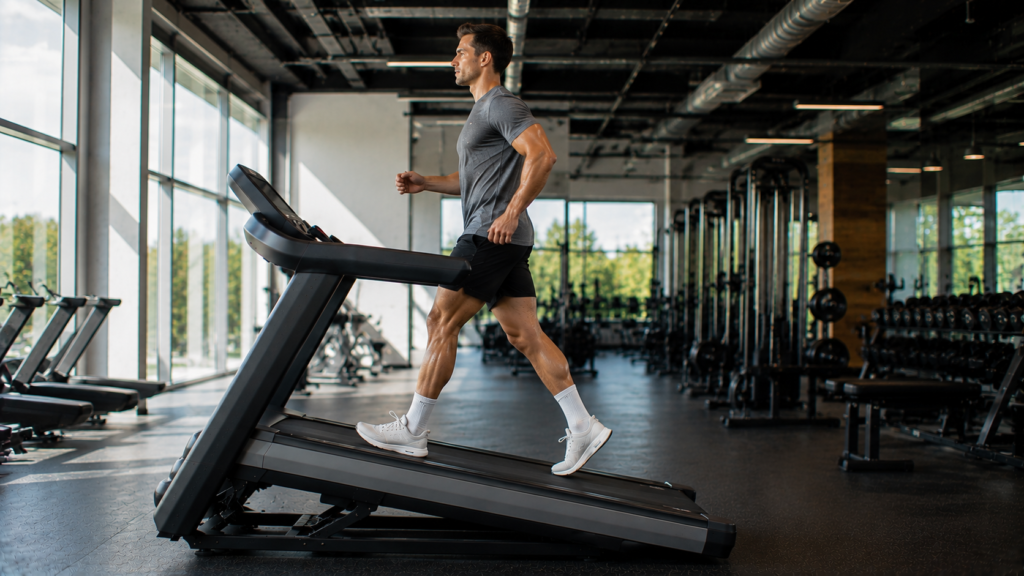
Common Incline Walking Mistakes That Reduce Your Results
Once you know the answer to does walking on an incline burn more calories, it can be tempting to simply increase the treadmill gradient and assume that higher always means better.
But several common mistakes can make incline walking less effective, less comfortable or unnecessarily difficult.
1. Setting the Incline Too High
A steep incline isn’t automatically a better incline.
If increasing the gradient causes your posture to collapse, forces you to dramatically reduce your speed or makes you depend heavily on the handrails, you’ve probably progressed too quickly.
Choose a gradient that genuinely challenges you while still allowing you to walk naturally.
Remember, the goal isn’t to reach the highest number your treadmill offers.
2. Holding Onto the Handrails
We’ve already touched on this, but it’s worth emphasising because it’s extremely common.
If you’re supporting yourself heavily with the treadmill rails, you’re changing the demands of the exercise.
Instead of setting the treadmill to 12% and hanging backwards from the handles, you may be better off reducing the gradient and walking naturally without support.
Briefly touching the rails for balance or while adjusting the machine is different from continuously relying on them throughout your workout.
If you’re asking does walking on an incline burn more calories, remember that the comparison assumes you’re actually performing the uphill walking rather than partially supporting your body with the machine.
3. Leaning Too Far Forward
A slight natural forward lean can occur when walking uphill, particularly from the ankles, but deliberately bending heavily at your waist isn’t necessary.
Try to keep your torso controlled, head looking forwards and shoulders relaxed.
Your stride may naturally become slightly shorter as the incline increases.
Don’t force exaggerated steps just because you’re walking uphill.
Good technique should allow you to maintain the session comfortably while your lower body performs the additional work.
4. Increasing Speed and Incline Together Too Quickly
Imagine you’ve been walking comfortably at 3 mph and 2% incline.
Increasing immediately to 4 mph and 10% dramatically changes the workout.
Instead, adjust one variable at a time.
You could increase the gradient while maintaining your usual speed, or increase your speed while keeping the gradient unchanged.
Once you’ve adapted, progress again.
This makes it much easier to identify what actually caused the workout to become harder.
5. Ignoring Pain
Incline walking should feel more challenging than flat walking, particularly through your cardiovascular system and lower-body muscles.
But challenging and painful aren’t the same thing.
If you experience persistent or worsening pain in your feet, ankles, knees, hips or back, don’t continue increasing the incline simply to burn more calories.
Reduce the workload and assess what’s causing the problem.
For people with existing health conditions, injuries or concerns about starting exercise, seeking individual advice from an appropriate healthcare professional may be sensible.
6. Assuming the Treadmill Calorie Number Is Exact
Treadmill calorie displays are estimates.
They may calculate energy expenditure using information such as workout duration, speed, incline and sometimes body weight, but they cannot perfectly account for every individual difference.
This means you shouldn’t finish a workout, see “400 calories” on the screen and automatically assume you’ve burned exactly 400 calories.
If you’re investigating does walking on an incline burn more calories, focus more on the general relationship between incline and exercise intensity than on treating machine estimates as laboratory measurements.
Outdoor Hills vs Treadmill Incline: Is There a Difference?
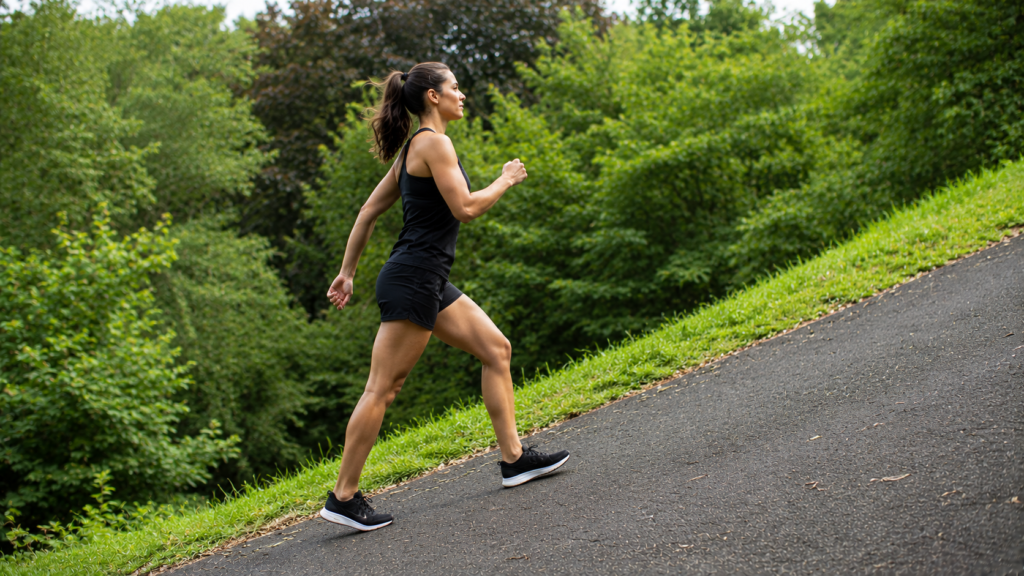
Incline walking doesn’t have to happen on a treadmill.
Walking uphill outdoors can provide many of the same basic benefits because you’re still moving your body against gravity.
However, the two experiences aren’t identical.
A treadmill allows you to precisely control:
- Speed.
- Gradient.
- Workout duration.
- Interval structure.
- Progression between sessions.
Outdoor walking is less predictable.
A real hill may become steeper or flatter throughout the route, the terrain can change and your walking speed naturally varies.
Outdoor routes also include downhill sections, which place different demands on your muscles compared with continuously walking uphill on a treadmill.
Treadmill vs Outdoor Incline Walking
| Factor | Treadmill Incline | Outdoor Hills |
| Gradient control | Precise | Constantly varies |
| Speed control | Precise | Self-selected |
| Weather | Controlled environment | Weather dependant |
| Terrain | Predictable | Can vary |
| Downhill walking | Usually absent | Often included |
| Workout tracking | Very easy | Device dependant |
| Scenery | Limited | Often greater variety |
Neither is automatically superior.
If you enjoy walking outdoors, hills can naturally increase the intensity of your route without requiring a gym.
If you prefer precise workouts, a treadmill makes it much easier to reproduce the same session and monitor your progression.
Most importantly, does walking on an incline burn more calories outdoors as well as on a treadmill?
Yes. Walking uphill still requires additional work against gravity. The exact calorie difference will depend on the steepness of the hill, your pace, body weight, terrain and workout duration.
Is the 12-3-30 Workout Good for Burning Calories?
The 12-3-30 workout became popular as a simple treadmill routine.
Traditionally, it involves setting a treadmill to:
- 12% incline
- 3 mph
- 30 minutes
For many people, that’s a demanding walking workout.
Because the gradient is steep, it will generally require substantially more effort than walking at 3 mph on a flat treadmill.
So if you’re wondering does walking on an incline burn more calories during a workout such as 12-3-30, the answer is generally yes compared with walking at the same speed and duration without the incline.
However, 12-3-30 isn’t a magical combination.
There’s nothing uniquely fat-burning about the numbers 12, 3 and 30.
The workout is simply one way of combining a relatively steep incline, purposeful walking speed and sustained duration.
For a beginner, 12% may be unnecessarily difficult.
If you have to grip the rails throughout the session just to complete it, reducing the incline may produce a more appropriate workout.
You could start with something such as:
5-3-30 — 5% incline, 3 mph, 30 minutes.
Then gradually progress towards:
7-3-30
9-3-30
and eventually 12-3-30 if you actually want to and can maintain good technique.
There is no requirement to reach the original version.
A personalised incline workout that matches your fitness is more useful than copying a viral routine simply because it’s popular.
How Often Should You Do Incline Walking?
How frequently you should incline walk depends on the intensity of your sessions and the rest of your exercise routine.
Someone performing gentle 20-minute incline walks may tolerate them much more frequently than someone completing hard 45-minute sessions at steep gradients.
For many people, two to four dedicated incline walking sessions per week can fit comfortably alongside other exercise.
But this isn’t a mandatory target.
Your weekly routine could include:
| Day | Activity |
| Monday | 30-minute moderate incline walk |
| Tuesday | Strength training |
| Wednesday | Flat outdoor walk |
| Thursday | 30-minute incline workout |
| Friday | Strength training |
| Saturday | Longer outdoor walk |
| Sunday | Rest or easy walking |
This allows you to benefit from incline walking without making every cardio session identical.
How often you exercise also matters more than completing one enormous session occasionally.
Recovery is still important, particularly if you combine incline walking with running, strength training or other demanding lower-body exercise.
Your calves and other leg muscles may initially feel more challenged by incline walking than you’re accustomed to.
Give your body time to adapt rather than immediately performing hard incline sessions every day.
When deciding does walking on an incline burn more calories enough to justify doing it daily, remember that calorie expenditure isn’t the only consideration. A balanced routine that you can recover from and maintain consistently is more valuable than simply maximising the difficulty of every workout.
Can You Do Incline Walking Every Day?
Some people can comfortably walk on an incline every day, particularly when the intensity and duration vary.
But there’s no requirement to do so.
Walking is generally suitable for frequent activity, but a steep treadmill session is more demanding than a casual walk.
If you want to walk daily, consider alternating harder and easier sessions.
For example:
- Monday: Moderate incline.
- Tuesday: Easy flat walk.
- Wednesday: Incline intervals.
- Thursday: Easy walk.
- Friday: Moderate incline.
- Saturday: Longer outdoor walk.
- Sunday: Easy recovery walk or rest.
This allows you to maintain a high level of general activity without turning every day into a difficult workout.
If your calves, feet or legs remain unusually sore from the previous session, reducing the incline or choosing an easier walk can make sense.
Consistency doesn’t mean performing the exact same workout every day.
How to Burn More Calories While Incline Walking
Now we can turn the answer to does walking on an incline burn more calories into practical improvements.
You don’t need to make dramatic changes.
Increase the Incline Gradually
If your current gradient has become comfortable, add a small amount rather than immediately jumping several percentage points.
For example, progress from 4% to 5% before considering 8% or 10%.
Increase Your Walking Speed
A slightly faster pace can increase exercise intensity without changing the gradient.
Again, make small adjustments.
Walk for Longer
If you currently complete 25 minutes comfortably, progressing towards 30 or 35 minutes increases the total amount of exercise performed.
Use Incline Intervals
Alternate between moderate and steeper gradients rather than maintaining one setting throughout the entire workout.
Avoid Leaning on the Rails
Choose settings that allow you to support your own body and maintain natural walking mechanics.
Stay Active Outside Your Workout
Your treadmill session is only one part of your daily activity.
Walking to the shops, taking stairs and accumulating steps throughout the day can further increase your total movement.
The best strategy isn’t necessarily doing all of these simultaneously.
Choose one progression, allow your body to adapt and then make another adjustment if needed.
Frequently Asked Questions
Does walking on an incline burn more calories than walking flat?
Yes. When speed, duration and other major variables are similar, walking uphill generally requires more energy than walking on level ground because your body has to work against gravity.
The greater muscular and cardiovascular demand usually increases energy expenditure.
Does walking on an incline burn more calories at the same speed?
Generally, yes.
If you maintain the same walking speed and duration but increase the gradient, the exercise usually becomes more demanding and calorie expenditure rises.
The exact difference depends on factors such as the incline, body weight and individual physiology.
What incline burns the most calories?
Higher gradients generally increase exercise intensity when other variables remain similar, but the highest incline isn’t automatically the best choice.
Choose a gradient that allows you to maintain good walking form without heavily gripping the treadmill rails.
For many people, moderate gradients provide a better balance between intensity and sustainability.
Is 10% incline good for walking?
A 10% gradient can create a challenging walking workout.
Whether it’s appropriate depends on your fitness, walking speed and experience.
Beginners don’t need to start at 10%. Lower gradients can still meaningfully increase the difficulty compared with flat walking.
Is 5% incline enough?
Yes.
A 5% incline can make walking noticeably more demanding than level walking, particularly when combined with a brisk pace.
You don’t need extreme gradients to benefit from incline walking.
Does incline walking burn belly fat?
Incline walking can contribute towards overall fat loss by increasing energy expenditure, but it cannot specifically target fat around your stomach.
Where your body loses fat is influenced by factors you can’t control simply by selecting a particular exercise.
Is incline walking good cardio?
Yes.
Walking at a sufficient intensity can provide cardiovascular exercise, and increasing the gradient is one way to raise that intensity.
The NHS recommends regular moderate or vigorous physical activity as part of a healthy lifestyle.
Is incline walking better than running?
Neither is universally better.
Running generally burns more calories per minute, while incline walking can provide a challenging workout at a walking pace and may be easier for some people to sustain.
Your goals, fitness and preferences should determine which you use.
Final Verdict
So, does walking on an incline burn more calories?
Yes.
When walking speed, workout duration and other major variables remain similar, increasing the incline generally increases the amount of energy your body needs to perform the exercise.
Walking uphill requires you to work against gravity, increases the demands placed on your lower-body muscles and typically raises cardiovascular intensity compared with walking on a flat surface.
But that doesn’t mean you should immediately set your treadmill to its maximum gradient.
A moderate incline that allows you to maintain good posture, walk without relying on the handrails and complete a meaningful workout can be far more useful than an extremely steep setting you can barely sustain.
If your goal is weight loss, remember that the answer to does walking on an incline burn more calories is only part of the picture. Your overall calorie intake, daily activity, exercise consistency and long-term habits ultimately determine your results.
Start with a manageable gradient, increase the challenge gradually and use incline walking alongside ordinary walking, strength training and other forms of activity you enjoy.
The best incline isn’t necessarily the steepest.
It’s the one that makes your walking more challenging while still allowing you to return and do it consistently.