

If you’re wondering how many steps a day to lose weight, you’ve probably heard one number more than any other: 10,000 steps. It appears on fitness watches, walking challenges and social media posts so frequently that many people assume reaching 10,000 steps automatically leads to weight loss.
The reality is more complicated.
There isn’t one perfect daily step target that guarantees weight loss for everyone. Your current activity level, body weight, walking intensity, diet and overall lifestyle can all affect how many steps a day to lose weight effectively.
Someone who currently averages only 3,000 steps per day may significantly increase their daily energy expenditure by progressing to 6,000 or 7,000 steps. Meanwhile, someone who already walks 10,000 steps every day but consistently consumes more calories than they burn may still struggle to lose weight.
That’s because walking supports weight loss by increasing the amount of energy your body uses throughout the day.
The more you move, the more calories you generally burn. However, those additional calories still need to contribute towards an overall calorie deficit if your goal is reducing body weight.
This is why answering how many steps a day to lose weight requires looking beyond one magic number.
Rather than simply telling everyone to walk 10,000 steps, this guide will explain the seven key secrets that determine the right daily step target for you. We’ll examine whether 5,000 steps can help you lose weight, whether 10,000 is really necessary, what happens when you reach 12,000–15,000 steps and how quickly you should increase your activity.
You’ll also learn how walking speed affects calorie expenditure, how your diet influences results and how to create a realistic step target that you can maintain for months rather than days.
By the end, you’ll have a much clearer understanding of how many steps a day to lose weight and how to use your daily step count as a practical tool for sustainable fat loss.

Secret 1: Your Starting Daily Step Count Matters
Before deciding how many steps a day to lose weight, you need to know how many steps you already take.
This is one of the most important parts of setting an effective walking goal because increasing your activity relative to your current level is often more realistic than immediately chasing an arbitrary number.
Imagine two people.
The first person averages 2,500 steps per day.
The second already averages 9,000 steps per day.
If both are told to reach 10,000 steps, the target represents two completely different changes in activity. The first person would need to add approximately 7,500 steps to their normal day, while the second only needs another 1,000.
For someone who has been relatively inactive, suddenly attempting thousands of additional steps every day may also make the routine unnecessarily difficult to maintain.
Instead, spend around one week monitoring your normal activity using your phone, smartwatch or fitness tracker. Try not to deliberately change your behaviour during this period. You simply want to establish your approximate baseline.
Once you know your average, gradually increase it.
Starting Step Target Guide
| Current Daily Average | Reasonable Initial Target |
| Under 3,000 steps | 4,000-5,000 steps |
| 3,000-5,000 steps | 5,500-7,000 steps |
| 5,000-7,000 steps | 7,000-9,000 steps |
| 7,000-9,000 steps | 9,000-11,000 steps |
| 9,000+ steps | Increase gradually if required |
These numbers aren’t guaranteed weight-loss targets. Instead, they demonstrate how you can progressively increase your activity without suddenly doubling or tripling the amount you walk.
The NHS recommends that adults aim to be physically active every day and reduce the amount of time spent sitting or lying down.
Gradual progression also gives your body time to adapt. Your feet, ankles, calves and other tissues are exposed to repeated loading during walking, so there is little benefit in immediately forcing yourself to complete a huge number of steps if you cannot maintain them comfortably.
When determining how many steps a day to lose weight, think of your baseline as the starting line rather than judging yourself against someone else’s activity.
If you currently average 3,500 steps and consistently increase that to 6,000, you’ve made a meaningful improvement.
Once 6,000 feels normal, you might progress towards 7,000 or 8,000.
This creates a sustainable habit instead of turning your step target into something you constantly fail to reach.
Ultimately, the best starting target is one that increases your normal activity while remaining realistic enough to repeat every day.
Secret 2: Your Body Weight Changes Your Calorie Burn
Not everyone burns the same number of calories from the same walk.
Your body weight is one factor that affects the energy required to move. Generally, a heavier person expends more energy covering the same distance at a similar speed than a lighter person.
That’s another reason there is no universal answer to how many steps a day to lose weight.
Your smartwatch may tell you that you’ve completed 10,000 steps, but the step count itself doesn’t reveal exactly how much energy you’ve expended.
Walking speed, distance, terrain, incline, body size and individual differences can all influence calorie expenditure.
If you want a deeper breakdown of how these variables affect walking calories, we’ve covered this separately.
Step length matters too.
Two people completing 10,000 steps may cover different distances because taller people generally have longer strides. This means step counts are excellent for monitoring activity, but shouldn’t be treated as perfectly precise measurements of distance or calories.
What Different Step Counts Can Represent
| Daily Step | Approximate Distance* | General Activity Level |
| 5,000 | 2-2.5 miles | Moderate daily movement |
| 7,500 | 3-3.75 miles | Moderately active |
| 10,000 | 4-5 miles | High daily walking volume |
| 12,500 | 5-6.25 miles | Very high daily walking volume |
| 15,000 | 6-7.5 miles | Extremely active day |
Distances are estimates because stride length varies between individuals.
This table also demonstrates why how many steps a day to lose weight shouldn’t be reduced to a single calorie figure.
A brisk 10,000-step day involving hills may require considerably more effort than 10,000 slow steps accumulated around your home and workplace.
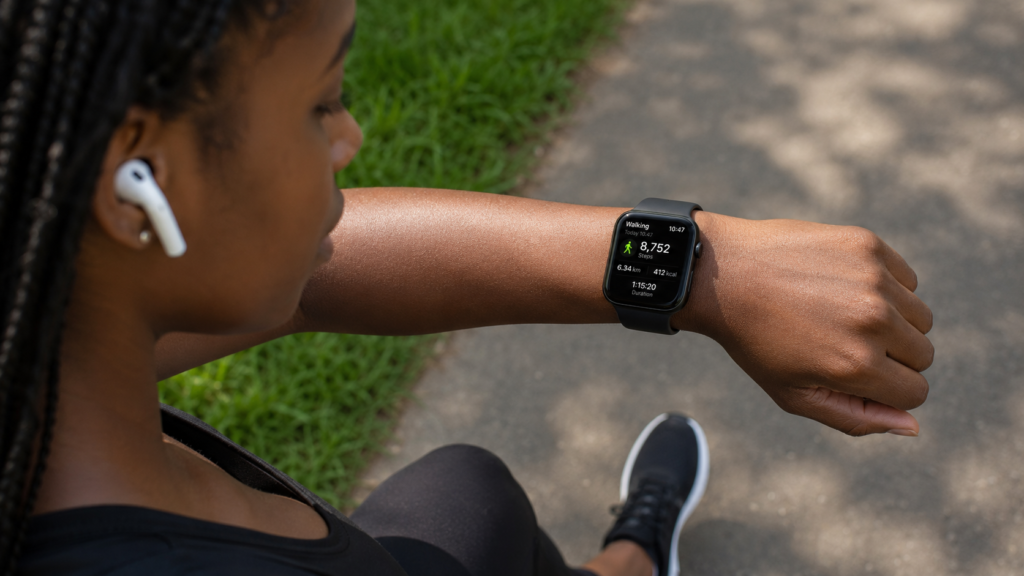
Fitness trackers can still be extremely useful. Their biggest advantage is consistency: using the same device allows you to compare your activity from one day or week to another.
However, avoid treating the calorie number displayed on your watch as permission to eat exactly that amount back. Wearable calorie estimates aren’t perfectly accurate.
Instead, use your step count to monitor activity and use changes in your body weight, waist measurements and general fitness to assess whether your overall approach is working.
Secret 3: Walking Speed and Intensity Matter
The number of steps you take matters, but how you take those steps matters too.
Walking 8,000 steps very slowly throughout an entire day isn’t physiologically identical to completing a large proportion of those steps during a purposeful brisk walk.
If you’re working out how many steps a day to lose weight, increasing the intensity of some of your walking can help you get more from your daily activity.
Brisk walking raises your heart rate, increases breathing rate and generally requires more energy than strolling slowly.
It also counts towards recommended moderate-intensity aerobic activity.
Adults should aim for at least 150 minutes of moderate-intensity activity each week, according to NHS physical activity guidance.
You don’t need to turn every walk into an exhausting workout.
A useful method is to divide your daily steps between ordinary movement and deliberate brisk walking.
For example, someone aiming for 9,000 steps might accumulate:
- 3,000 steps through normal movement at home and work.
- 2,000 steps while travelling, shopping or completing errands.
- 4,000 steps during a dedicated brisk walk.
This allows you to increase overall movement while still completing a meaningful period of cardiovascular exercise.
A simple way to judge intensity is the talk test. During moderate-intensity activity, you should generally be able to talk but not sing comfortably because your breathing has become faster.
Hills can increase the challenge further.
Walking uphill requires your leg muscles to work harder and increases cardiovascular demand without requiring you to start running. A treadmill incline can provide a similar effect if you prefer walking indoors.
However, faster isn’t automatically better.
If increasing your pace leaves you so tired that you drastically reduce your walking duration or start skipping sessions, the additional intensity may work against you.
When deciding how many steps a day to lose weight, the goal should be to find a balance between total step count, walking intensity and consistency.
A slightly slower 60-minute walk that you genuinely enjoy may ultimately contribute more to your weekly activity than an extremely intense 20-minute walk that you constantly avoid.

Secret 4: Your Diet Determines Whether Your Steps Lead to Weight Loss
You could walk thousands of steps every day and still struggle to lose weight if your overall calorie intake remains higher than the amount of energy your body uses.
This is one of the most important things to understand when asking how many steps a day to lose weight.
Walking increases your daily energy expenditure, but weight loss ultimately requires an overall calorie deficit. This means that, over time, your body needs to use more energy than you consume through food and drink.
For example, imagine that increasing your daily walking helps you burn additional calories each week. If you unknowingly compensate by eating larger portions, drinking more high-calorie drinks or snacking more frequently, some or all of that additional energy expenditure can be cancelled out.
That doesn’t mean you need to follow an extreme diet.
In fact, combining regular walking with small, sustainable improvements to your diet is usually far more realistic than drastically restricting your food intake.
Simple habits can include:
- Prioritising protein-rich foods at meals.
- Eating plenty of fruit and vegetables.
- Choosing higher-fibre foods.
- Being aware of portion sizes.
- Limiting frequent high-calorie snacks.
- Choosing water or lower-calorie drinks more often.
- Planning meals rather than relying on impulsive choices.
The NHS recommends aiming for gradual, sustainable weight loss rather than attempting to lose weight extremely quickly.
This is particularly important because increasing your activity can sometimes increase your appetite. After a long walk, you may feel hungrier than usual and unintentionally consume more calories than you burned.
You don’t necessarily need to count every calorie you eat. However, having a basic understanding of energy balance can make it much easier to understand how many steps a day to lose weight successfully.
Think of walking and nutrition as two parts of the same strategy.
Walking helps increase the amount of energy you use.
Your diet influences the amount of energy you consume.
When the two combine to create a sustainable calorie deficit, your body can gradually use stored energy and your weight can decrease over time.
This is also why there isn’t a step count that automatically guarantees weight loss.
One person may lose weight averaging 7,500 steps per day because their nutrition supports a calorie deficit. Another person could average 12,000 steps and maintain their current weight because their calorie intake matches their total expenditure.
When determining how many steps a day to lose weight, therefore, don’t judge your walking routine in isolation. Your overall diet still matters enormously.

Secret 5: Consistency Matters More Than One Huge Step Count
Reaching 15,000 steps on Saturday might look impressive on your fitness tracker, but it won’t necessarily compensate for being almost completely inactive throughout the rest of the week.
When considering how many steps a day to lose weight, consistency is one of the biggest factors separating a sustainable routine from a short-lived challenge.
Walking regularly allows those relatively small amounts of additional energy expenditure to accumulate across weeks and months.
Consider two hypothetical routines:
Weekly Step Comparison
| Routine | Daily Pattern | Weekly Steps |
| Person A | 10,000 every day | 70,000 |
| Person B | 15,000 twice + 4,000 on five days | 50,000 |
| Person C | 8,000 every day | 56,000 |
| Person D | 12,000 three days + 3,000 on four days | 48,000 |
This doesn’t mean the person with the highest weekly total will automatically lose the most weight. Diet, body size, intensity and other activity still matter.
What the table demonstrates is how consistency can quietly produce a substantial amount of movement.
Someone completing 8,000 steps every day reaches 56,000 steps per week without ever completing an enormous walking day.
This is useful when working out how many steps a day to lose weight because your target needs to fit into your real life.
If 12,000 steps requires two hours of walking that you simply don’t have available every day, it may be a poor target even if it looks impressive on paper.
An 8,000-step target that you can reliably reach could be far more valuable.
You can also spread your steps throughout the day rather than completing them in one continuous session.
Walk before work.
Take a short walk during lunch.
Use the stairs when practical.
Walk part of your journey home.
Go outside for 15 or 20 minutes after dinner.
These short periods of movement can accumulate surprisingly quickly.
This is particularly useful if sitting occupies a large part of your day. The World Health Organization recommends that adults limit sedentary time and replace sedentary behaviour with physical activity where possible.
There will inevitably be days when you don’t reach your target. Missing one day doesn’t mean you’ve failed, and there’s usually no reason to force yourself through an enormous walk the following day just to compensate.
Instead, look at your pattern across the entire week.
If you’re trying to establish how many steps a day to lose weight, the most useful target is usually one that encourages you to move more consistently without making walking dominate your entire schedule.
Secret 6: Your Other Exercise Counts Too
Your step count isn’t the only form of physical activity your body performs.
This becomes especially important when determining how many steps a day to lose weight if you already exercise regularly.
Someone who completes three strength-training sessions, two runs and several walks each week has very different activity demands from someone whose only deliberate exercise is walking.
If both people are told they must complete 12,000 steps every single day, the recommendation ignores everything else they’re doing.
Running is a good example.
Running generally covers distance faster and at a higher intensity than walking, meaning a person who regularly runs may not need to obsess over matching the daily step count of someone whose primary form of exercise is walking.
Strength training matters too.
Resistance exercise can help maintain or increase muscle, improve strength and complement the calorie expenditure provided by walking.
The NHS recommends that adults perform strengthening activities that work the major muscle groups on at least two days each week.
A balanced week might therefore look something like this:
| Day | Main Exercise | Step Target |
| Monday | Strength training | 7,000-8,000 |
| Tuesday | Brisk walk | 9,000-10,000 |
| Wednesday | Strength training | 7,000-8,000 |
| Thursday | Brisk walk | 9,000-10,000 |
| Friday | Rest / normal activity | 6,000-8,000 |
| Saturday | Longer walk or other cardio | 10,000-12,000 |
| Sunday | Easy recovery walk | 7,000-9,000 |
This is only an example rather than a prescription. Your appropriate activity level depends on your fitness, schedule, recovery and health.
The important point is that how many steps a day to lose weight shouldn’t be considered separately from the rest of your training.
If you perform a demanding gym workout or another form of cardio, forcing yourself to complete thousands of extra steps purely because your watch hasn’t reached an arbitrary target may not always be necessary.
Walking can instead complement your other exercise.
On harder training days, you might naturally complete fewer steps. On rest days, a comfortable walk can help keep your overall activity higher without adding another intense workout.
This approach makes your weekly routine more flexible while still allowing walking to contribute meaningfully towards your weight-loss goals.

Secret 7: Your Step Target Should Increase as Your Fitness Improves
The final secret is that your ideal step target doesn’t have to stay the same forever.
When you’re first figuring out how many steps a day to lose weight, increasing your activity from 4,000 to 7,000 steps might represent a substantial change. After several weeks or months, however, that same amount of walking may become a normal part of your routine.
Your body adapts, your fitness improves and walking longer distances can begin to feel easier.
That doesn’t mean you need to keep increasing your steps indefinitely.
Instead, progression should be gradual and based on whether your current routine is still helping you achieve your goals.
For example, someone might progress like this:
Example 8-Week Step Progression
| Week | Average Daily Step Target |
| 1 | 5,000 |
| 2 | 5,500 |
| 3 | 6,000 |
| 4 | 6,500 |
| 5 | 7,000 |
| 6 | 7,500 |
| 7 | 8,000 |
| 8 | 8,500 |
This isn’t a schedule everyone needs to follow. Someone already averaging 8,000 steps would obviously need a different starting point, while a complete beginner might need longer at each stage.
The principle is simply to make manageable increases rather than jumping immediately from very little activity to an enormous daily target.
When deciding how many steps a day to lose weight, pay attention to how your body responds as well.
Persistent foot, ankle, knee or hip pain isn’t something you should ignore simply because your fitness tracker says you haven’t reached your target. Your walking volume should be something your body can tolerate consistently.
Progression can also come from changing how you walk rather than endlessly adding more steps.
Once you’re comfortable with your current volume, you could:
- Walk slightly faster.
- Include more hills.
- Add a treadmill incline.
- Take a longer route occasionally.
- Include dedicated brisk walks.
- Combine walking with other forms of exercise.
That gives you several ways to make your routine more challenging without eventually feeling like you need to spend your entire day chasing steps.
If your weight is gradually decreasing and your current routine feels sustainable, there may be no reason to increase your target at all.
This is an important point.
More isn’t automatically better.
The goal of learning how many steps a day to lose weight is to find the amount of activity that helps produce results while still fitting comfortably into your lifestyle.
So, How Many Steps a Day Do You Actually Need to Lose Weight?
Now that we’ve covered all seven factors, we can answer the main question more directly.
There is no single step count that guarantees weight loss.
However, increasing your daily steps above your normal baseline can increase your energy expenditure and make it easier to establish the calorie deficit required for weight loss.
For many people, gradually working towards somewhere around 7,000–10,000 daily steps can provide a practical activity goal.
But that isn’t a magic range.
You could potentially lose weight while averaging fewer than 7,000 steps if your overall activity and diet create a calorie deficit. Equally, walking more than 10,000 steps doesn’t guarantee weight loss if your calorie intake remains too high.
Research has also challenged the idea that exactly 10,000 steps is required to obtain meaningful health benefits. Studies have observed associations between health benefits and step counts below 10,000, with the relationship varying according to the outcome and population being studied.
So when you’re deciding how many steps a day to lose weight, a better approach is:
- Measure your current average.
- Increase it gradually.
- Keep some of your walking brisk.
- Maintain a sustainable calorie deficit.
- Monitor your results.
- Adjust your target when necessary.
Your progress matters more than whether your watch displays exactly 10,000 at midnight.
Is 5,000 Steps a Day Enough to Lose Weight?
Yes, 5,000 steps a day can contribute to weight loss, but whether it’s enough depends on the rest of your lifestyle.
For someone previously averaging only 2,000–3,000 steps, reaching 5,000 consistently represents a meaningful increase in physical activity.
Those additional steps increase energy expenditure and can contribute towards a calorie deficit.
However, if you’re asking how many steps a day to lose weight because you want the fastest possible results, 5,000 steps may leave room for further increases—particularly if most of your day is otherwise sedentary.
Rather than dismissing 5,000 as “not enough,” treat it as a potential milestone.
If you can comfortably maintain 5,000 steps, you could eventually progress towards 6,000, 7,000 or beyond.
The important part is that your activity increases in a way you can sustain.
Is 10,000 Steps a Day Enough to Lose Weight?
For many people, 10,000 steps represents a substantial amount of daily walking.
Depending on your stride length, it may equate to roughly four or five miles of movement accumulated throughout the day.
That can make a meaningful contribution to your overall calorie expenditure.
However, 10,000 steps still doesn’t automatically cause weight loss.
If you consume approximately the same amount of energy that you expend, your weight may remain relatively stable regardless of your step count.
This is why the answer to how many steps a day to lose weight cannot simply be “10,000.”
Think of 10,000 as a potentially useful activity target rather than a biological threshold that suddenly activates fat loss.
If you’re already completing 10,000 steps consistently and aren’t losing weight, don’t immediately assume you need 15,000.
First consider your overall calorie intake, other exercise, consistency and how long you’ve actually been following your routine.
What About 12,000-15,000 Steps a Day?
Increasing your daily movement beyond 10,000 steps can increase your total energy expenditure further.
For someone who enjoys walking, has enough time and has gradually adapted to higher volumes, 12,000–15,000 steps may be perfectly manageable.
But you don’t need to reach those numbers simply because more steps appear better.
When considering how many steps a day to lose weight, remember that the goal is sustainable fat loss—not winning a step-count competition.
Higher targets also require more time. Depending on your walking speed and the steps you naturally accumulate throughout your day, reaching 15,000 may require a considerable amount of dedicated walking.
If that fits naturally into your lifestyle, that’s fine.
If it requires you to reorganise your entire day, sacrifice recovery or constantly walk late at night because your tracker says you’re behind, a lower sustainable target may make more sense.
There’s also no need to jump directly from 7,000 to 15,000.
Build gradually and see how your body responds.

How Long Does it Take to See Results From Walking?
Once people establish how many steps a day to lose weight, the next question is usually how quickly they should expect results.
There isn’t one exact timeline.
Your starting body weight, calorie deficit, diet, activity level and consistency can all affect the rate at which your weight changes.
Healthy weight loss is generally gradual rather than dramatic.
This is another reason you shouldn’t judge your walking programme after only a few days.
Body weight naturally fluctuates because of hydration, food intake and other factors. A short-term increase on the scales doesn’t necessarily mean your programme isn’t working.
Instead, assess trends over several weeks.
You can monitor:
- Body weight under similar conditions.
- Waist circumference.
- Average daily steps.
- Walking pace.
- Walking distance.
- How your clothes fit.
- General fitness and energy levels.
If you’re consistently more active, maintaining appropriate nutrition and gradually seeing positive changes, there’s little reason to obsess over achieving an even higher step number.
The purpose of determining how many steps a day to lose weight is to create a repeatable activity habit that supports your overall weight-loss strategy—not to make the number on your fitness tracker your only measure of success.
Common Mistakes When Using Steps for Weight Loss
Even after understanding how many steps a day to lose weight, several common mistakes can make your walking routine less effective.
Avoiding these mistakes can help you get more from the steps you’re already taking without unnecessarily increasing your walking volume.
1. Assuming 10,000 Steps Guarantees Weight Loss
One of the biggest mistakes is treating 10,000 steps as a guaranteed weight-loss formula.
You can reach 10,000 steps every day and still maintain or even gain weight if your overall calorie intake consistently exceeds your energy expenditure.
Likewise, someone averaging fewer than 10,000 steps could lose weight if their overall lifestyle creates a sustainable calorie deficit.
Your step count is therefore a useful activity target, not a guarantee of weight loss.
When asking how many steps a day to lose weight, always consider your nutrition alongside your walking routine.
2. Increasing Your Steps Too Quickly
Going from 3,000 steps one day to 15,000 every day the following week isn’t necessary.
Although walking is generally accessible and relatively low impact, rapidly increasing the amount you do can still leave your feet and lower body feeling sore.
A better strategy is gradual progression.
Add a manageable number of steps to your current average, allow that level of activity to become comfortable and then increase again if necessary.
This approach is particularly important for beginners who haven’t exercised regularly for a long time.
3. Eating Back Every Calorie Your Watch Says You Burned
Fitness watches can be excellent tools for tracking steps, distance and activity trends, but calorie estimates should be interpreted cautiously.
If your watch estimates that you burned 500 calories during your activity, that doesn’t necessarily mean you should immediately consume an additional 500 calories.
Research has found variation in the accuracy of wearable devices when estimating energy expenditure.
Instead of relying entirely on the calorie number displayed by your device, monitor your activity and weight trends over time.
If you’re learning how many steps a day to lose weight, your smartwatch is best used as an activity-monitoring tool rather than a perfect calorie calculator.
4. Only Walking When You’re Doing a Workout
Your dedicated walk isn’t the only opportunity to accumulate steps.
Small periods of movement throughout your day can make a considerable difference to your weekly total.
You could:
- Walk during your lunch break.
- Take the stairs.
- Walk short journeys instead of driving.
- Get off public transport slightly earlier.
- Walk while making a phone call.
- Take a short walk after dinner.
- Park further from your destination.
These small changes can increase your daily movement without requiring another full workout.
This is particularly useful when determining how many steps a day to lose weight if you have a busy schedule and can’t dedicate an hour every day to walking.
5. Thinking More Steps Are Always Better
Once people start tracking steps, it’s easy to become obsessed with continually increasing the number.
First 8,000 feels good.
Then you want 10,000.
Then 12,000.
Eventually, you may feel like anything below 15,000 is a bad day.
That’s unnecessary.
If your current step count supports your goals, fits your lifestyle and allows you to recover properly, you don’t need to increase it simply for the sake of seeing a bigger number.
Exercise should support your health rather than become a competition with your fitness tracker.
How to Get More Steps Without Doing a Long Walk
Knowing how many steps a day to lose weight is useful, but reaching that target can seem difficult when you have work, family responsibilities or other commitments.
Fortunately, your steps don’t need to come from one continuous workout.
Adding several short periods of movement throughout the day can dramatically increase your total.
For example, imagine you normally complete around 5,000 steps.
You could add:
| Activity | Approximate Extra Steps |
| 10-minute morning walk | 1,000 |
| 10-minute lunchtime walk | 1,000 |
| Walking during a phone call | 500 |
| Taking stairs / walking extra at work | 500 |
| 15-minute evening walk | 1,500 |
| Potential additional steps | 4,500 |
These numbers are approximate because walking speed and stride length vary, but the principle is what matters.
A person starting at 5,000 steps could potentially move towards 8,000–9,000 without needing to schedule one enormous walking session.
This is one reason walking can be such an accessible form of exercise.
You can build movement around activities you’re already doing.
If you drive to work, park slightly further away.
If you use public transport, consider walking part of the journey.
If you’re watching television, take a short walk during a break.
If you’re meeting a friend, suggest going for a walk rather than sitting the entire time.
These changes may appear insignificant individually, but repeated every day they can add thousands of steps to your week.
When considering how many steps a day to lose weight, making your environment naturally encourage movement can be easier than relying entirely on motivation.

Sample Daily Step Plan for Weight Loss
If you’re still unsure how many steps a day to lose weight, the following progression provides an example of how someone currently averaging around 4,000–5,000 steps could gradually become more active.
This isn’t a mandatory programme. Adjust it according to your current activity level, fitness and schedule.
| Weeks | Daily Step Target | Main Goal |
| 1-2 | 5,500-6,000 | Establish consistency |
| 3-4 | 6,500-7,000 | Increase daily movement |
| 5-6 | 7,500-8,000 | Add regular brisk walking |
| 7-8 | 8,500-9,000 | Build walking capacity |
| 9-10 | 9,000-10,000 | Maintain a higher activity level |
| 11+ | Adjust as required | Maintain or progress |
You don’t need to increase your target simply because you’ve reached the next week.
If 7,000 steps still feels challenging, stay there until it becomes manageable.
Similarly, if you’re already comfortably averaging 10,000 steps, starting at 5,500 obviously wouldn’t make sense.
Your starting point should always reflect your current activity.
This is why the question how many steps a day to lose weight has a different answer for different people.
The best plan is progressive, sustainable and flexible enough to survive busy weeks rather than collapsing as soon as your routine changes.
Frequently Asked Questions
How many steps a day to lose weight?
There isn’t one number that guarantees weight loss, but gradually increasing your steps above your current activity level can increase daily energy expenditure and support a calorie deficit.
For many people, working towards approximately 7,000–10,000 steps per day can be a practical goal, but your appropriate target depends on your diet, starting activity level, body weight, exercise routine and ability to remain consistent.
Can I lose weight walking 5,000 steps a day?
Potentially, yes.
If 5,000 steps represents an increase from your previous activity and your overall lifestyle creates a calorie deficit, weight loss is possible.
However, as your fitness improves, gradually increasing your activity may provide additional benefits.
Will I lose weight walking 10,000 steps every day?
Not automatically.
Walking 10,000 steps can substantially increase your daily activity, but weight loss still depends on overall energy balance.
Your nutrition therefore remains important regardless of how many steps a day to lose weight you choose as your target.
How many steps are in a mile?
A commonly used estimate is roughly 2,000–2,500 steps per mile, although the actual number varies according to stride length, height and walking pattern.
Someone with a longer stride may require fewer steps to cover one mile than someone with a shorter stride.
Is 15,000 steps a day too much?
Not necessarily.
Someone who has gradually adapted to high walking volumes may comfortably complete 15,000 steps.
However, you don’t need to reach 15,000 simply to lose weight. If a lower step target already supports your goals and fits your lifestyle, increasing it may be unnecessary.
Is walking better than running for weight loss?
Running generally burns more calories per minute, while walking is lower impact and can often be performed for longer or more frequently.
Which is better depends on your fitness, preferences and ability to remain consistent.
Final Verdict
So, how many steps a day to lose weight?
There isn’t a magic number.
For many people, gradually progressing towards approximately 7,000–10,000 daily steps can be a realistic way to increase physical activity. But reaching exactly 10,000 steps isn’t a requirement for losing weight, nor does it guarantee results.
Your starting activity level, body weight, walking intensity, nutrition, consistency, other exercise and progression all influence the amount of walking that makes sense for you.
Those are the seven factors that matter far more than blindly chasing a number on your smartwatch.
If you’re currently averaging 3,000 steps, don’t feel like you’ve failed because you’re nowhere near 10,000. Increase your activity gradually and allow your body and routine to adapt.
If you’re already completing 10,000 steps, don’t assume you automatically need 15,000. Look at your overall progress first.
Ultimately, understanding how many steps a day to lose weight means finding a level of walking that increases your energy expenditure while remaining realistic enough to maintain long term.
Combine that walking with balanced nutrition, appropriate strength training and an active lifestyle, and your daily steps can become one useful part of a sustainable weight-loss strategy.